


Align, Empower, Execute. I call this the AEE Cycle - the fundamental cycle of any execution that occurs in an organization. Whether the work is being done by engineering teams, or even just basic projects - managing the cycle effectively a powerful management tool for achieving leverage and project success and operational efficiency.
AEE - The Cycle
AEE is simple conceptually:
Your team needs to know what to do (Align)
Your team needs resources to do it (Empower)
Your team needs to go and do it (Execute)
It’s a cycle - once the team executes, something in the environment might change that invalidates assumptions, necessitates a change in the direction, or perhaps just to catch natural goal drift. The team then goes back to Align at some point in the future, going through the cycle again, and again, and again.
That helps keep the team on track, focused on execution, and ensures that projects don’t stall.
Align - Providing the team clarity
Alignment is the most important activity to start with. You want to point your team in the right direction so that their efforts can be put into productive ends. To do this, you align and provide the details.
I recommend creating a document that articulates all of this precisely, though you can also do this verbally.
What do you want to achieve?
One-sentence should be enough to describe this. If you need more, you probably don’t have the necessary clarity of thought.
Why do you want to achieve this?
While “because I want to” might be fine for you, it has to be understandable and acceptable to your team. The Why? matters a lot because it also shapes decisions.
“Because it’s a great side market with potential for 10x growth 5 years from now” causes the team to make very different decisions than “Because it’s an existential crisis for the company if we don’t get this done.”
Under what constraints?
Time - Is there a deadline or schedule?
Money - Is there a cost limit, or alternatively - a minimum investment?
Effort - Is this a sole focus, or one of several projects? Where does it fall in prioritization?
Quality - Is there a desire to make it great, or is it a ‘get it out the door’ to get speed to market?
Scope - Is there need to be comprehensive solution, or would an MVP be acceptable?
Explain why each tradeoff is what it is. Why is the deadline there? Is it for alignment with GTM, something required by a customer, a made up number? Why do we want to invest this much money in it, and is there wiggle room?
What do you NOT want to achieve?
This is one a lot of leaders forget, which leads to an accrual of alignment failures during execution. People need to know what not to do and what not to worry about.
If you have a team full of high-initiative people, they may, in their efforts to be pro-active, go down a completely different path towards a completely different destination than you actually need.
It’s a common source of scope-creep. You need to give people boundaries and anti-goals: things you definitely do not want to do or happen.
An anti-goal might be something like:
For example, if the goal given to a growth team is “Increase signups by 5%”, an accompanying anti-goal might be: “We do NOT want to change the sequence of steps within the sign-up or user registration experience.”
A common trap
Just remember - explaining something is different than justifying something.
Explaining is providing reason behind decisions, which teams benefit from as they make decisions. Justifying is proving that your reasoning is legitimate for approval.
You’re the leader - the only person you have to justify your decisions to your is your boss. Your team has no approval authority.
Once explained, you should set the expectation that your team commits - even if they disagree. Make sure decision-rights are clear, otherwise you create opportunities for additional alignment problems through your attempts to align. It’s a common trap a lot of leaders fall into that creates execution friction later on.
Empower - Meeting team needs
Once your team understands what they need to do, under what constraints, and why, it’s now your job to empower them.
Empowerment is simple - conceptually:
Give people the resources they need - money, time, focus, freedom, etc.
Give people the knowledge they need - clarification, expectation, etc.
Give people the capabilities they need - authority, skills, access, etc.
Give people boundaries - ie. emphasize what they don’t need and won’t get
Give people the resources they need
This might look like authorizing and specifying a budget. It might mean deprioritizing other projects or work. It might mean getting stakeholders off their backs so they can focus.
Give people the knowledge they need
This might be providing a central place to find documentation like meeting notes, explainers, or links to other artifacts.
It at minimum means you’ve taken the alignment and written it down.
Give people the capabilities they need
Do they need access to a SaaS tool? Get them access. Do they need a connection with another team? Do the intro. Do they need borrowed authority to make decisions in a space? Connect the stakeholders and tell them who the deciders are. Do this ahead of time so that it doesn’t create wait time and delays during execution.
Give people boundaries
Once again - tell people what they won’t get. If they ask for a tool and you aren’t going to give it to them, don’t tell them “let me check”, tell them “You aren’t going to get that tool for this project.” It helps avoid wasted time from the team pursuing pathways that lead to dead-ends.
Execute - Letting your team work
After Align and Empower, it’s your time for you to step back.
You’ve aligned and provided clarity, including expectations of behavior
You’ve empowered the team, providing them what they need
Step back. Let the team cook.
Your active over-involvement here will likely cause more issues and misalign teams. They’ll read your interventions as reprioritization, changes to the boundaries and constraints, and it’ll create re-work, hesitancy, doubt, and sloppiness as implementations pivot back and forth.
To effectively let a team execute, you need to delegate. The rules of delegation are simple but difficult emotionally:
Even the most highly competent team will take different paths to achieve the same result. You must judge the outcome and how it met the constraints, not the process by how it got there.
Over nit-picking on implementation that ultimately doesn’t change the outcome will reduce empowerment and alignment, completely stalling a project’s execution.
You must be available and responsive and provide direction, but not controlling.
These are hard things to do. You’ll see the team do things that you feel are a waste of time, or are not how you would do it. You, as the leader, need to step back and let them maneuver within the boundaries you have provided.
The only exception to this - key efforts during wartime mode, where the how matters as much as the what. In that case, you should have already set the expectation during alignment so the team is operating in the right posture and you retain direct control.
Keeping a close eye
If you’re working in an organization, chances are you can’t just leave teams alone for months at a time hoping they are doing their work. You have people to report to, other efforts to coordinate, risks to manage and mitigate, interventions to perform.
Once the team executes - you need to check their progress.
This is the beauty of the Align, Empower, Execute cycle: we’re back to Align!
Touchpoints
How? By establishing supervision touch-points. These are moments you bake in ahead of time where you can ensure that the work is being done in the manner it needs to be done, help address any uncertainties that have arisen, or respond and react to new discoveries.
Depending on the effort or its importance or its rate of change your supervision touch-points might range anywhere from monthly to hourly in extreme cases.
While I don’t recommend hourly except for crisis-related efforts, weekly is a good place to start - it’s enough time for work to get done but also enough time where something may have changed about the environment or work.
How frequently you have your touch-points is an entire science / art all on its own I’ve written about before - tempo.
Milestones
For more autonomous, experienced teams, you can switch from a time-based tempo to a Milestone-based tempo.
Instead of checking in and aligning on a set frequency, check in and align according to milestones. These might be specific project phases (eg. RFC, Beta Release, GTM) or key dates (eg. 2 weeks post-start, project mid-point).
This gives you the ability to track to the granularity you need without requiring wasted alignment effort.
Just note - you really need a pro-active, autonomous team for this approach to work. If a team spins its wheels and never gets to Beta Release, you run the risk of introducing wasted time or even a complete project failure if you don’t have enough time to get the project back on track. Choose your milestones carefully.
Milestones might look like phase gates:
When the team starts discovery
When the team develops an execution plan
When the team starts implementation in earnest
When the team has a working prototype
When the team has a functional end-to-end flow
When the team is ready for testing
When the team is ready for GTM
or they might look like deliverables:
When the team delivers the MVP
When the team delivers the Search feature
When the team delivers the Filter feature
or some combination - the milestones are theoretically infinite - you can have extreme granularity or high levels of abstraction.
Optimizing the cycle
Alignment, Empowerment, and Execution isn’t just a single, linear path. It’s a cycle. You Align, Empower, Execute, Align, Empower, Execute, Align, Empower, Execute until the project is done.
The key here is optimizing for the entire cycle.
Here’s a very difficult truth: the only value creation that occurs here is execution. Ideas are endless, it’s what happens with those ideas that turns it into reality that matters.
The trap is that many leaders attempt to achieve the above by ignoring Alignment and Empowerment and focusing on Execution, which paradoxically reduces time spent in Execution dramatically due to the confusion and chaos it creates. It breaks the cycle, leading to extra effort to align and empower and less time spent on executing.
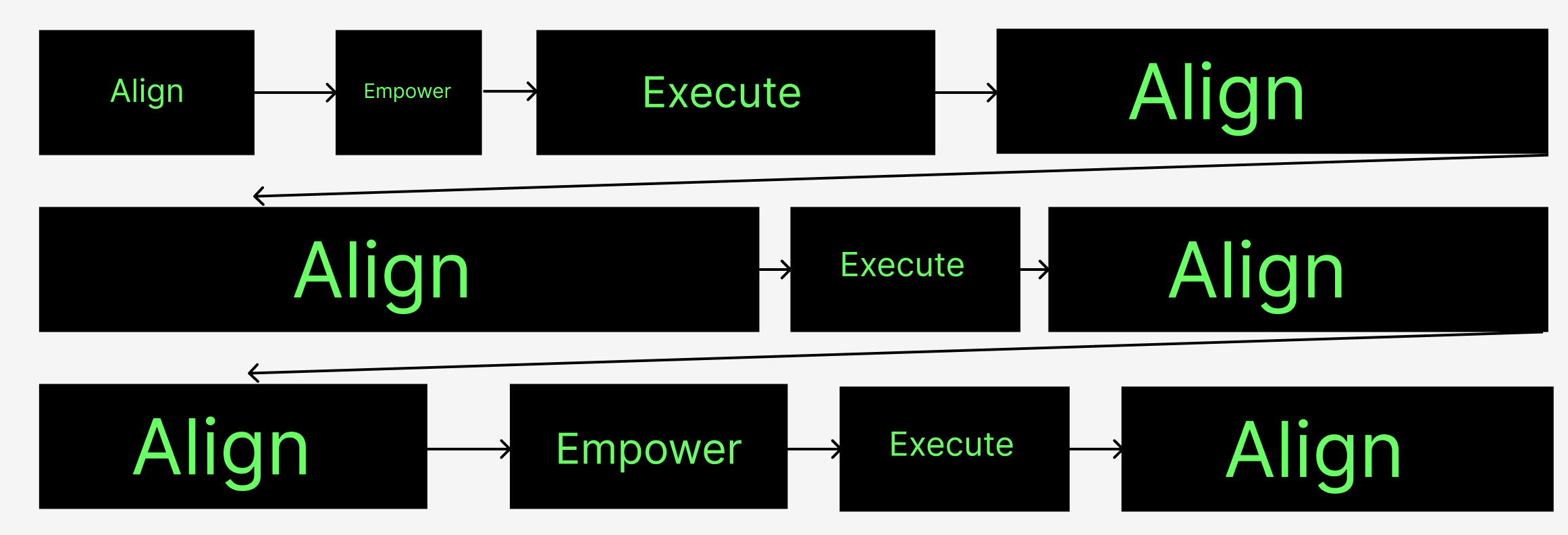
If you’re leading a team, you actually want to have AEE cycles where you spend as minimal amount of time and effort necessary in Alignment and Empowerment and maximize your team in Execution, but to achieve that - you have to effectively Align and Empower.
Spend more to spend less
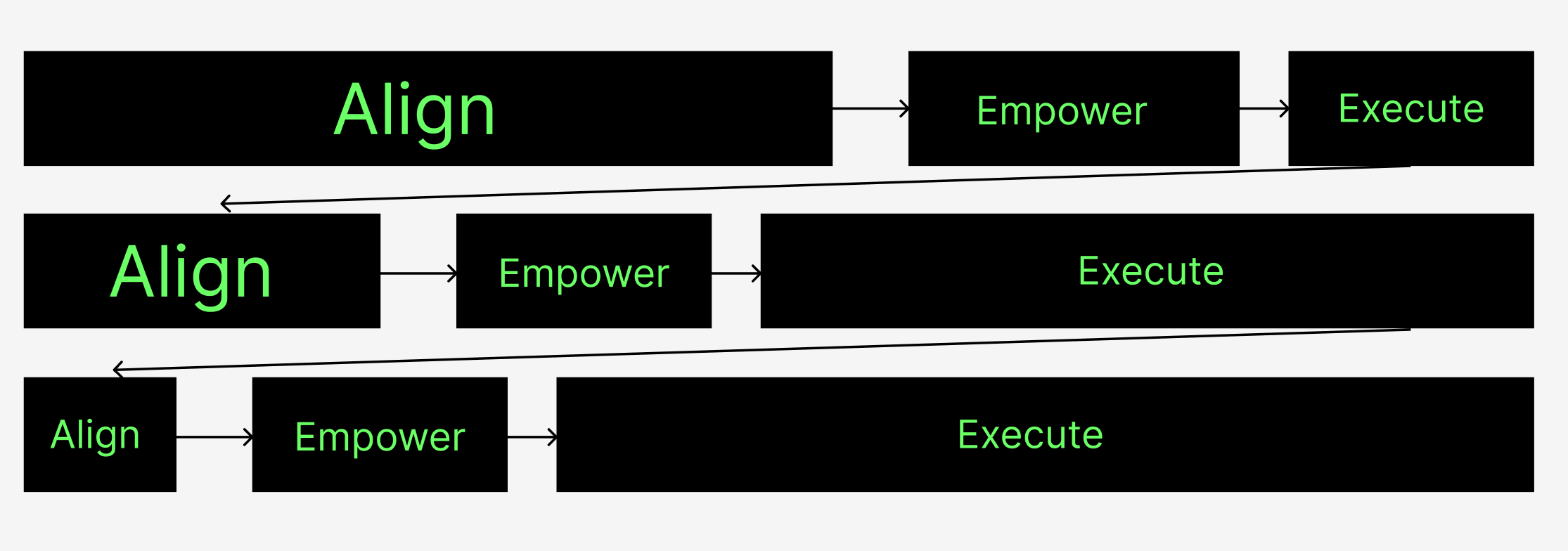
Shortening the alignment cycle is your primary goal, and you do that by focusing on the alignment cycle. Yes, it’s a paradox. To spend less time on alignment, you must spend more time on alignment.
The better you align initially and maintain that alignment, the less time you have to spend outside of Execution. The more Empowerment you provide the team, the less you have to spend struggling with Execution friction caused by a lack of Empowerment.
An hour spent on alignment upfront will literally save dozens of hours of waste in Execution. Getting your team what they need up front will save time during execution waiting for the things they need or working around it.
Are you over-aligning?

Weekly multi-hour meetings. Multiple daily check-ins. There are symptoms of an under-aligned team practicing alignment theater. You might need it for more complex, rapid change endeavors, but a single team or initiative under no duress should not require more than 30m a week to align on.
These are moments where you should step in - is there clarity missing? Is there ritualistic behavior that’s not leading to better execution? Don’t just leave teams sleepwalking - step in and intervene: cut out meetings, facilitate the outcomes yourself, adjust the process.
A useful tool - The Weekly Alignment
The weekly alignment is a very useful tool for team-level leaders to manage the AEE Cycle within their team without over-aligning. At the beginning of every week, share with your team and walk through a document that outlines:
Goal - the clear, 1-sentence goal the team is moving towards
Anti-goal - any outcomes the team doesn’t want to achieve
Current context - any specific things for that week that might impact the work
End state of this week - what a successful week would look like
At the team level, this can be very granular. For example:
Weekly Alignment - 10/30
Goal
Complete the fundraising ‘add a tip’ feature by the 11/30 marketing deadline.
Anti-goals
Lose the trust of users by miscalculating tips or lacking transparency
Burn out the team through overwork or unreasonable expectations
Launch without coordination with the GTM team
Current context
Brent is going on vacation for 2 weeks starting 10/14.
Consumer-facing design conceptual mocks have been approved by leadership, but details and workflows for admin side not yet completed.
End state of this week:
Have completed conceptual designs of Admin workflows by Thursday.
Have a recording of the MVP of the Consumer experience usable by internal testers by Friday.
This requires a PR built, reviewed, and deployed by Thursday EOD to Staging.
Have a shared marketing calendar for the Add a Tip GTM events available to everyone by Friday.
Combined with an asynchronous daily update, you can get a pulse without putting in over-bearing ritualistic behaviors. Better yet, this structure can be adapted to support higher-level efforts or lower frequency touchpoints.
Alignment is a key activity as a leader, but the purpose of it is not to align - the purpose of it is to increase relative time spent in execution.
Understanding the cycle fundamentals and how to provide clarity is a key component of efficient, effective, aligned teams.
Gefroh is an engineering and product executive in Kirkland, Washington. He frequently writes about Leadership, Management, Operations, AI, and Product Engineering on his blog.